COGANU AI DESKTOP · RESEARCH USE ONLY
Candidate rankings on your lab's PC
From efficacy evidence to clinical-entry review: installable desktop software that weighs each candidate's efficacy evidence (target, binding, cell response) together with its developability (ADMET, safety, public clinical information) to estimate candidate rankings for the next step. The computation finishes on the lab's own PC, and customer research data is not sent off it.
We publish the numbers
Measured by us on public benchmarks. What each number measured, and its limits, are stated in an evidence file that ships with the software.
{
  "schema_version": "coganu.pose-rescorer-evidence.v1",
  "weights_sha256": "9325869f7ecefd55…a798c3e0aca973dc67",
  "benchmark": { "n": 427, "vina_top1": 202, "rank_sum": 218,
                 "wins": 30, "losses": 14, "mcnemar_p": 0.023 },
  "astex_46": { "vina_top1": 27, "rank_sum": 31,
                "measures": "re-ranking of frozen Vina poses only (no re-docking)" }
}
genscore_clean_v1.evidence.json, shipped inside the software. It records the weight hash and what the number measured. The 1.04 Å above is the full product path (SMILES → docking → pose selection); the 27 → 31 in the file is a separate comparison that re-ranks frozen poses without re-docking.It follows the order research actually takes
Not a list of features. Four questions that narrow a candidate set, each with the tool that answers it, in one workspace.
Is the target worth it?
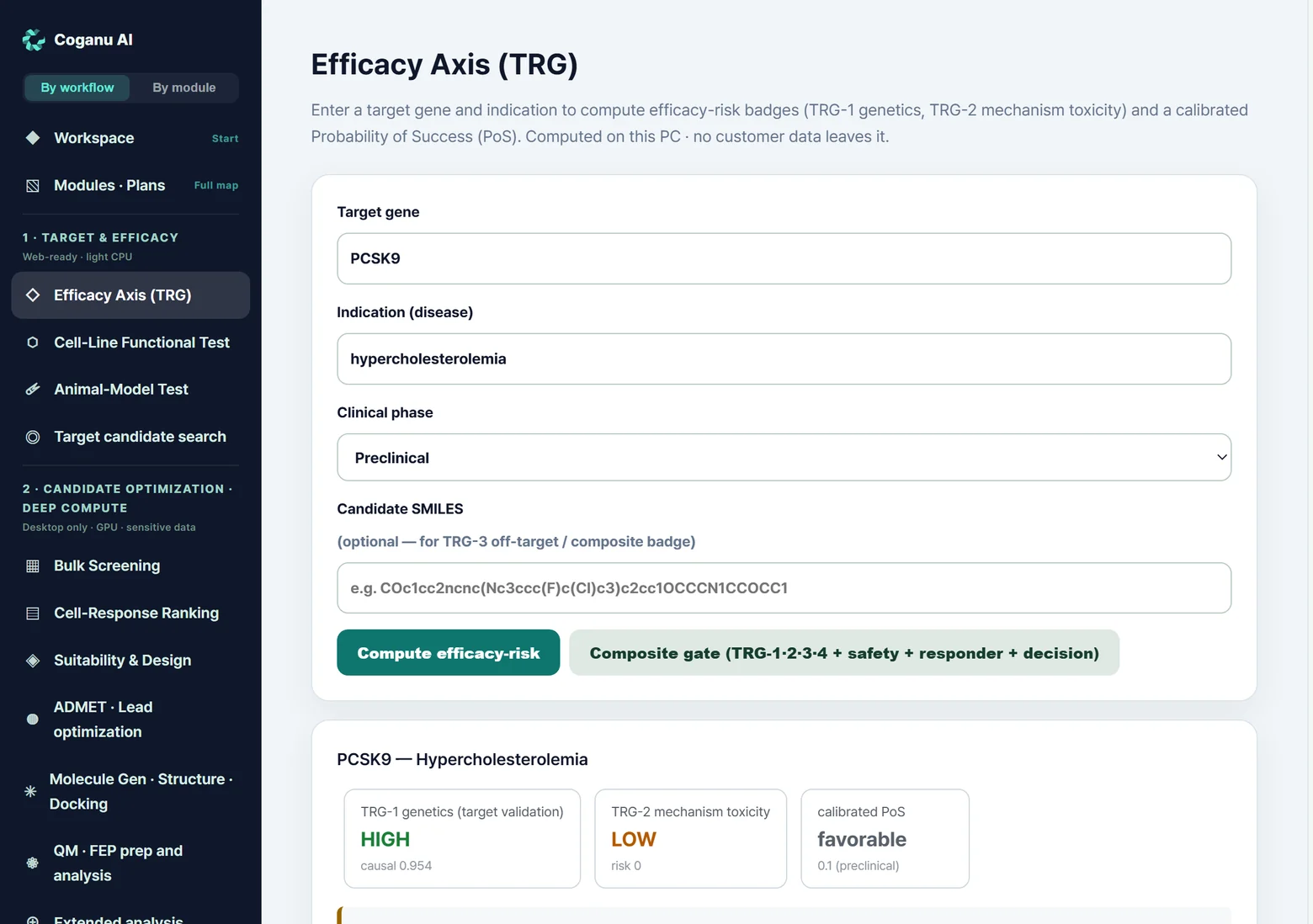
No GPUSummarises target evidence from public genetics and cell-line dependency data, and ranks which targets to look at first.
Does it bind?
DesktopRuns structure prediction and docking, then selects which generated pose to trust, with a confidence badge.
Does the cell respond?
DesktopEstimates cellular response from expression signatures and ranks which cell lines to assay first.
Can it be made, and is it safe?
DesktopCollects ADMET predictions with their applicability domain, plus public clinical and safety data, into material for the go/no-go call.
What it does, concretely
Target and efficacy evidence
Summarises target evidence and cell-line dependency from public genetics and cell-line data.
ADMET and lead optimisation
Shows absorption, metabolism and toxicity predictions together with their applicability domain.
Structure and docking
Protein–ligand pose generation, docking and computational-chemistry helpers.
Repurposing and combinations
Ranks repurposing and combination candidates from expression signatures and public data.
Clinical and safety information
Collects public clinical-trial and safety data into material for risk review.
ADC and cancer-vaccine design aids
Helper tools for organising linker, payload and epitope candidates.
Your research data does not leave your PC
Structures, sequences, assay values, queries and results are all processed on the customer's PC. Nothing is uploaded to us for computation and sent back.
- Computation finishes locally
- The models are installed on the PC too. No request carries research data.
- Account traffic carries no research data
- Only sign-in, licence checks and updates. A PC with no internet access is activated with a signed licence file.
- Public-registry lookups are the exception, and we say so
- Features that query public registries — clinical trials, adverse events, cancer genomics — send the name you typed to that organisation. The default is not to send; each lookup has to be allowed separately. The software lists exactly what can leave and where it goes.
- We do not train on customer data
- Our models are trained on public data. Nothing a customer enters is reused.
Pricing
One seat = one registered PC. Because computation runs on your PC, nothing is charged automatically by usage — you add more only when you choose to.
Academic research · 1 PC
$30–$100 / month
For researchers at universities and public or non-profit research institutions · Basic $30 · Plus $100 · monthly card subscription
Researchers and companies · 1 PC
$200–$800 / month
Commercial use included · Pro $200 · Pro+ $400 · Max $800 · monthly card subscription
Annual institutional contract · lab (3 PCs)
Company $27,600/year · non-profit $14,000/year (invoice, PO, bank transfer)
In Korea: company KRW 40m/year (excl. VAT) · non-profit KRW 20m/year (incl. VAT)
- Monthly subscriptions renew automatically until cancelled; cancel online at least 24 hours before renewal. The free demo is one per person (or organisation) with no time limit, up to 1 minute of compute (3D docking up to 2 runs). No card is registered and the demo never converts to a paid subscription — you are charged only when you start a payment yourself.
- End within 7 days of your first payment and we refund the compute time you have not used (we show this rule and ask you to agree before payment; without that agreement, or for EU/UK consumers, the refund is in full). Mid-term cancellation, tax, and the role of our Merchant of Record (Paddle, Polar) are covered in the Refund Policy and Terms.
- Every plan includes monthly compute time (Basic 5 h · Plus 15 · Pro 30 · Pro+ 60 · Max 120 h). It refills every billing cycle. If you run short, buy an extra-time pack (50% of your plan's monthly time, one per billing cycle, for that cycle only — e.g. Pro +15 h for $125) or move to a higher plan; either is charged only when you choose it. Deductions follow the table for our reference PC, so a slower PC of yours is not charged more — the per-task table and the PC you need are on System Requirements.
- Institutional and organisation enquiries: support@coganu.com